
The WS2813 and DMX512 are both lighting control technologies but differ significantly in design, application, and operation. Here's a structured breakdown of their differences:
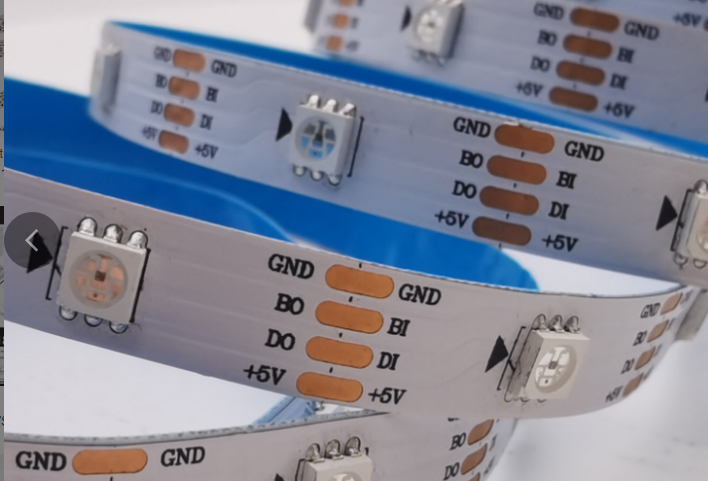
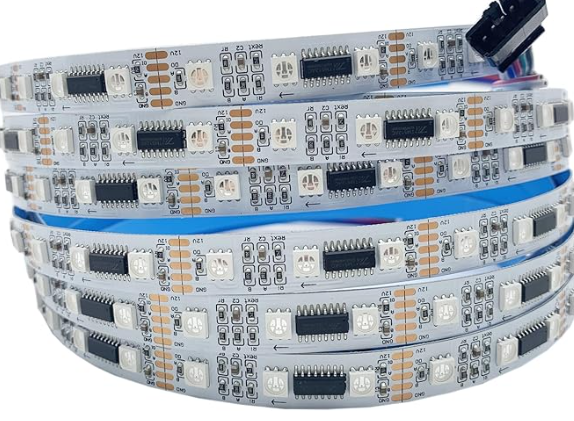
1. Protocol Type
- WS2813:
- Uses a timing-based serial protocol (1-wire, with optional backup data line).
- Each LED is controlled by precise high/low pulse durations (e.g., 800 kHz data rate).
- Data is passed sequentially down the LED chain; no error correction.
- DMX512:
- A packet-based standard (RS-485 differential signaling) with structured frames.
- Transmits 512 channels per "universe" at 250 kbps, with start codes and slots for fixtures.
- Minimal error checking via break/mark-after-break signals.
2. Control Method
- WS2813:
- Direct per-LED addressing (each LED auto-reads its 24-bit RGB data from the stream).
- Strict daisy-chain topology; LED position in the chain determines its data.
- DMX512:
- Channel-based addressing; fixtures are assigned a starting channel (e.g., RGB light uses 3 channels).
- Flexible addressing; fixtures ignore data outside their assigned channels.
3. Physical Layer
- WS2813:
- Single-ended signal (3.3V/5V logic), prone to noise over long distances.
- Simple wiring (data + power lines), often with separate high-current power injection.
- DMX512:
- Differential signaling (RS-485) for noise resistance, using shielded twisted-pair cables.
- Standard XLR connectors (3-pin or 5-pin).
4. Scalability
- WS2813:
- Limited by data timing (e.g., 30fps for ~1,000 LEDs) and voltage drop.
- Requires repeaters or signal boosters for long runs.
- DMX512:
- Up to 32 devices per universe (with splitters/repeaters for expansion).
- Multiple universes (via separate cables/interfaces) for large setups.
5. Applications
- WS2813:
- Decorative lighting, LED art, matrices, and projects needing individual LED control.
- Common in DIY/hobbyist projects (e.g., Arduino, Raspberry Pi).
- DMX512:
- Professional lighting (stages, theaters, architectural lighting).
- Controls fixtures like spotlights, dimmers, and RGB washes.
6. Power Delivery
- WS2813:
- Requires significant 5V/12V power injection along the strip.
- Power and data often share PCB traces (but power is typically handled separately).
- DMX512:
- Only transmits control signals; fixtures require separate power supplies.
7. Hardware & Controllers
- WS2813:
- Microcontrollers (Arduino, ESP32) with libraries (FastLED, NeoPixel).
- No specialized hardware beyond a GPIO pin.
- DMX512:
- Requires DMX controllers/interfaces (hardware or USB-to-DMX).
- Professional lighting consoles or software (e.g., QLC+, LightJockey).
8. Error Handling
- WS2813:
- No error correction; data corruption affects downstream LEDs.
- Backup data line (in WS2813) reduces failure risk if one LED breaks.
- DMX512:
- Minimal error checking; relies on robust physical layer for reliability.
Summary Table
| Feature | WS2813 | DMX512 |
|---|---|---|
| Protocol | Timing-based serial | Packet-based RS-485 |
| Addressing | Per-LED in chain | Channel-based (per-fixture) |
| Topology | Daisy-chain | Daisy-chain or split (with hardware) |
| Max Devices | Hundreds (limited by timing) | 32 devices per universe (512 channels) |
| Noise Immunity | Low (single-ended) | High (differential) |
| Use Case | Hobbyist/Decorative | Professional/Stage |
| Power Handling | Integrated (requires injection) | External (fixture-specific) |
| Typical Controllers | Microcontrollers | DMX consoles/interfaces |
When to Use Which?
- WS2813: Small to medium projects with individual LED control (e.g., home décor, wearables).
- DMX512: Large-scale, professional setups requiring robustness and flexibility (e.g., concerts, theaters).