
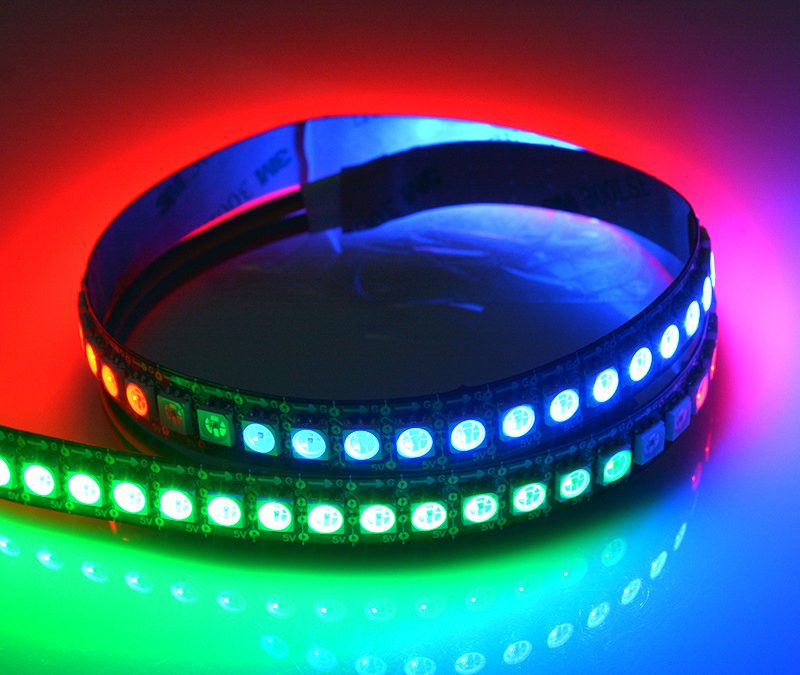
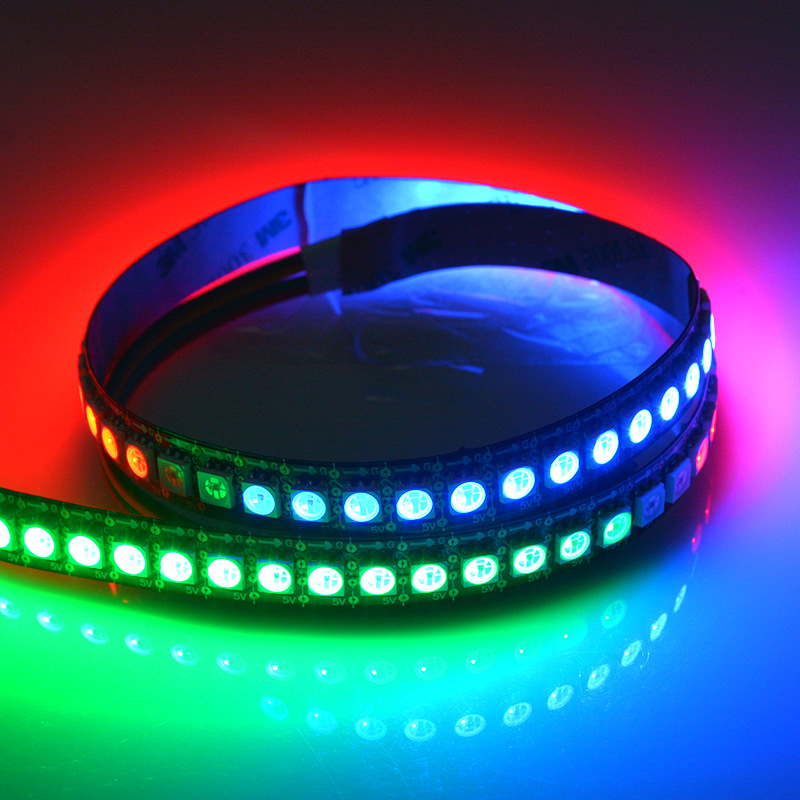
The APA102 single-point single-control strip light is a programmable LED strip light based on the APA102 chip, with the ability to independently control each LED light bead. This type of strip light has a wide range of applications in lighting, decoration, and display, and its core advantages lie in the high refresh rate and precise color control. The following introduction will cover technical features, application scenarios, and comparisons with other types of strip lights.
1. Technical features
The core of the APA102 single-point single-control strip light is the APA102 driving chip, which is a dual-line digital LED driving IC. Compared with traditional single-line LED strips such as WS2812B, the APA102 uses a dual signal transmission method with a data line (DATA) and a clock line (CLK). This design brings the following advantages:
-Higher refresh rates: Since the clock signal is transmitted independently, the APA102 can typically achieve refresh rates of thousands of Hz, far higher than the hundreds of Hz of single-wire strip lights, suitable for dynamic displays or high-speed photography scenes.
-Lower signal interference: The dual-wire system reduces signal delay and distortion issues, especially when long light strips are connected in series.
- Support PWM dimming: The APA102 chip is equipped with a built-in PWM controller, which can achieve smoother brightness adjustment and avoid the flicker problem caused by low-frequency PWM.
2. Comparison with other LED strips
(1) Comparison with WS2812B
WS2812B is a common single-wire strip of lights, which is low cost but has obvious limitations:
- Refresh rate limited: Strict timing control is required for single-line transmission, the refresh rate is usually below 1 kHz, and stripes may appear during high-speed photography.
-Signal is easily attenuated: additional signal amplifiers are needed when connected in series over long distances, while APA102 is more stable under the same conditions.
(2) Comparison with conventional RGB LED strips
Traditional RGB strip lights use a whole-control method, where all the LED beads can only display the same color, whileAPA102 single-point single-control can achieve independent programming for each LED bead, suitable for scenarios that require dynamic effects.
3. Application scenarios
The precise control characteristics of the APA102 single-point single-control strip light make it suitable for the following applications:
-Ambiance lighting: Through programming to achieve gradient, breathing and other effects, used for home or commercial space decoration.
- Film and television shooting: High refresh rate to avoid flashing under the camera, often used as a fill light or background light.
-Creative display: When combined with a controller, it can form a dot matrix screen or an art installation, such as a music visualization device.
4. Precautions for use
-Power requirements: Long LED strips need to be powered in sections to avoid insufficient brightness at the end of the lights due to line voltage drop.
-Heat dissipation design: It is recommended to use an aluminum heat sink for high brightness operation to extend the life of the LED.
-Programming compatibility: The main control device must support the SPI protocol or dedicated library functions (such as the FastLED library for Arduino).
5. Purchase Suggestions
Choose the density of the LED beads (commonly 30/60/144 beads per meter) and the waterproof grade (bare board, silicone sleeve, etc.) according to the requirements. If the budget is limited and the refresh rate is not a high priority, WS2812B might be more economical; if performance is sought after, APA102 is a better choice.
To sum up, the APA102 single-point single-control strip light excels in scenarios requiring fine control due to its high refresh rate and stable signal transmission. Its technical characteristics determine that it is more suitable for professional-level applications than traditional solutions, but it is also necessary to pay attention to the supporting design and cost investment.